
Build Strong Computer Foundations. Learn to Think, Code & Create.
Dr. RMK Indian Academy's structured BCA coaching and academic preparation is designed to strengthen computer fundamentals, programming concepts, mathematics, logical reasoning, problem solving and technology-oriented learning.
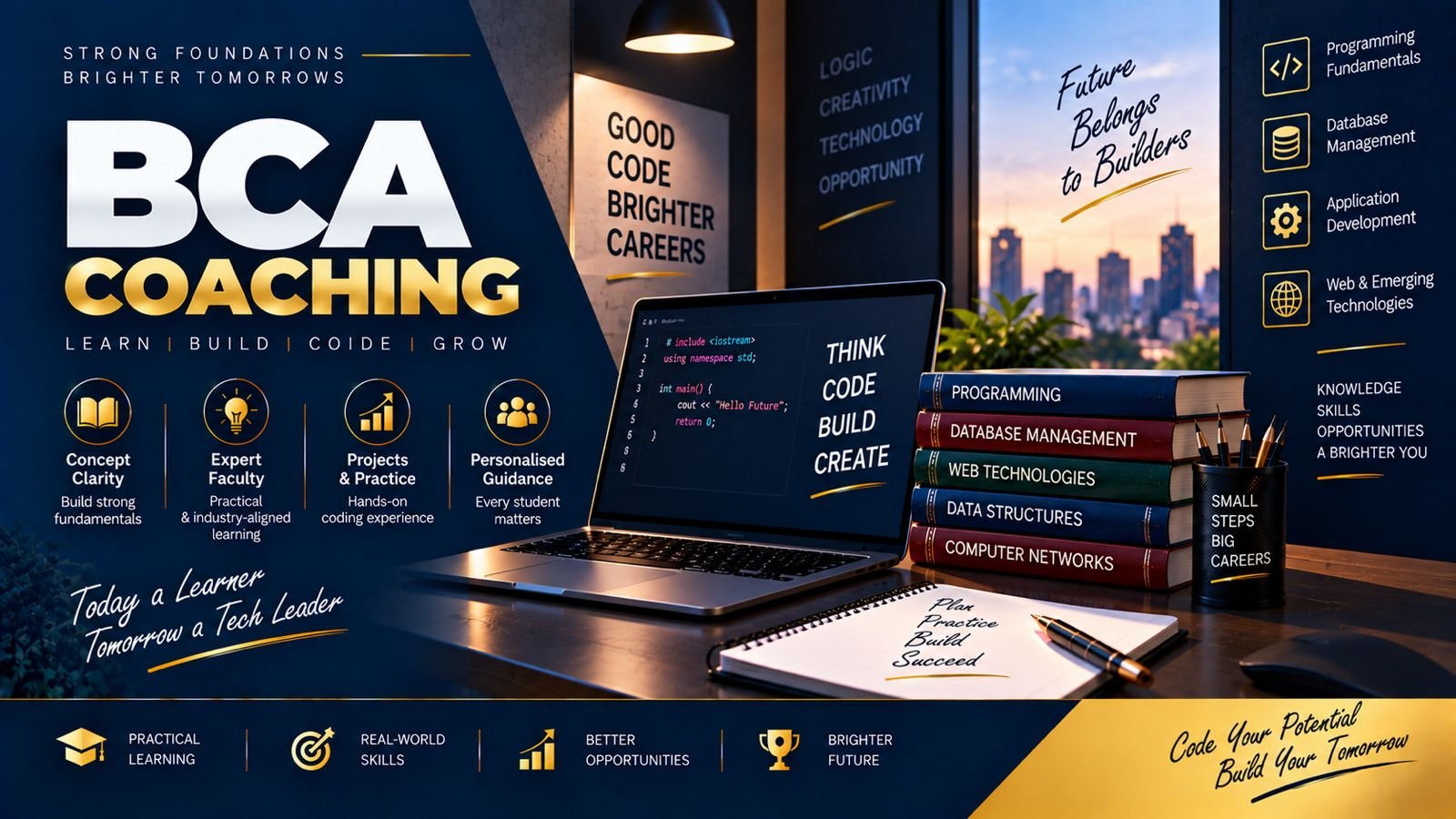
Bachelor of Computer Applications (BCA) is an undergraduate degree focused on computer applications, programming, software fundamentals, database concepts, web technologies, computer networks, problem solving and analytical thinking.
The actual BCA curriculum differs between universities and institutions. Admission requirements may also differ. Students should verify the latest eligibility, admission requirements and curriculum of the institution they intend to join.
Develop structured thinking and coding confidence.
Strengthen analytical and problem-solving skills.
Understand how computers and software work.
Students build programming logic through variables, data types, operators, conditional statements, loops, functions, arrays, basic algorithms, debugging and problem solving. Programming languages and curriculum depend on the institution and course structure.
/* Problem → Logic → Algorithm → Code → Test → Debug → Solution */
Mathematical reasoning, logical thinking, problem solving, numerical concepts, analytical ability and pattern recognition are developed. Mathematics requirements vary across BCA curricula and institutions.
Exact curriculum varies by university.
HTML, CSS, JavaScript, web structure, responsive design, basic UI concepts, client-side logic and web applications are introduced as foundational topics depending on the academy's curriculum.
HTML + CSS + JavaScript = Web Foundation
Data, tables, records, relationships, queries, database concepts, data organisation and SQL awareness are introduced as foundational topics.
Logical thinking, pattern recognition, structured reasoning, problem decomposition, algorithms, decision making and debugging mindset are developed through practice.
BCA admission pathways vary. Some institutions admit based on qualifying examination performance, some conduct entrance examinations, and others use institution-specific criteria.
Regular assessments to track understanding.
Hands-on coding and logic practice.
Simulated evaluation and performance analysis.
Concepts
Accuracy
Logic
Problem Solving
This dashboard represents the type of academic areas reviewed, not actual student performance data.
Every Student Learns Technology Differently.
We assess strengths and weaknesses, clarify doubts, monitor performance and provide personalised guidance through regular reviews and mentoring.
The roadmap can be adapted based on the student's academic level and institution-specific requirements.
Technology education is strengthened through practice rather than passive reading alone.
Practical learning through suitable academic projects such as simple websites, basic web applications, database projects, student management concepts and mini projects.
Possibilities include MCA, MBA / Technology Management where eligible, specialised technology certifications and postgraduate technology programs. Eligibility varies by institution and program.
Students have access to reference books, computer science resources, programming resources, practice material, question banks, revision resources, academic notes and digital resources where available.
Learning support designed to extend beyond classroom hours. Students have access to recorded classes where available, digital learning resources, programming practice, revision, self-study, library, mentoring and academic support.
We maintain regular communication with parents through progress awareness, academic discussions, performance review and improvement guidance.
Reach out to us with your questions.
Discuss academic needs and program fit.
Choose the right learning pathway.
Complete the admission process.