
Build Strong Foundations. Master Science. Prepare for What Comes Next.
Dr. RMK Indian Academy's PUC Science program for 1st and 2nd PUC students is designed to provide structured academic learning, conceptual clarity, regular practice, assessments, revision and guidance across PCMB, PCMC and PCME combinations.
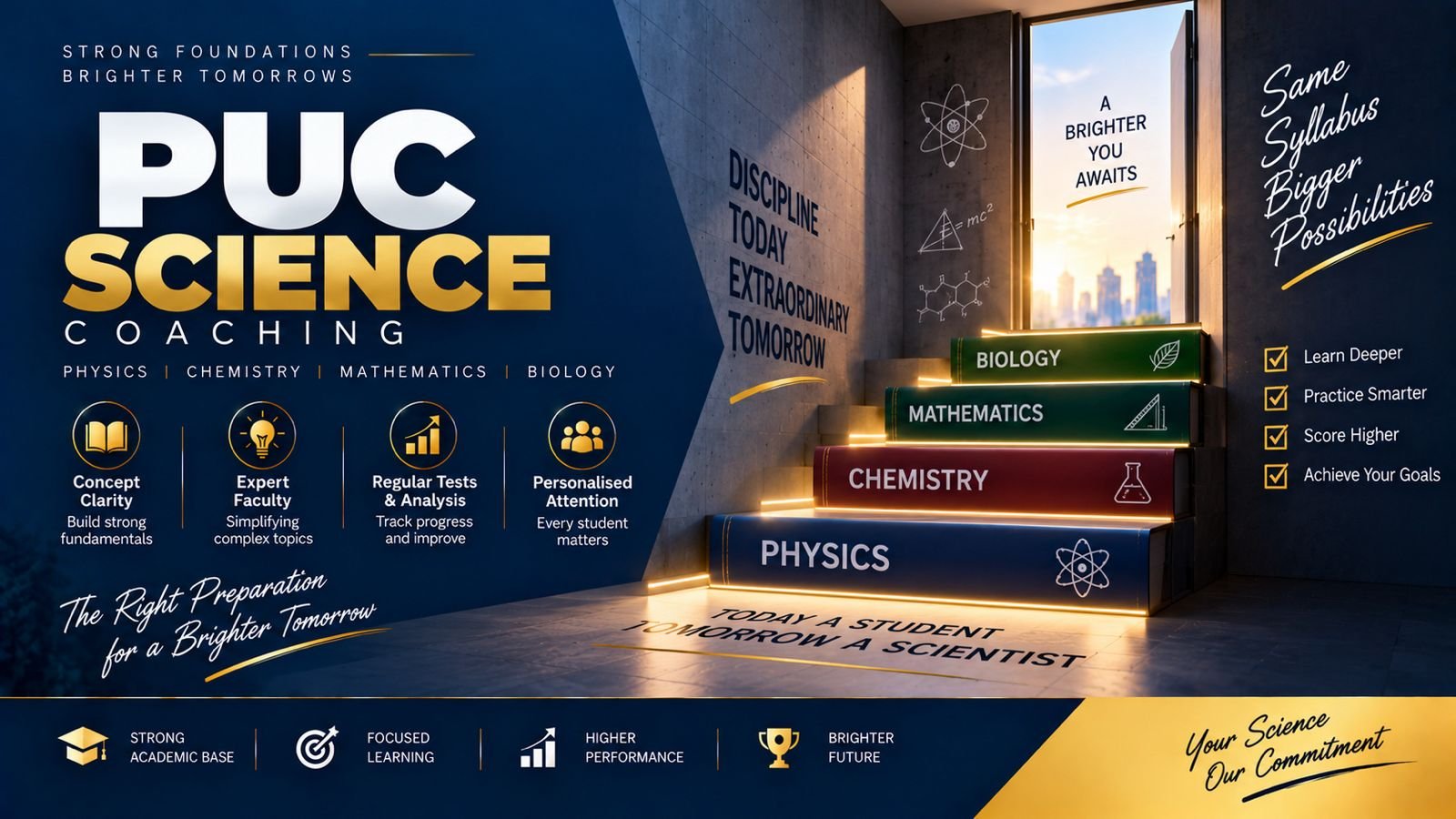
PUC Science represents a significant transition from school-level science to higher secondary education. Students encounter greater subject depth, more independent learning, conceptual complexity and the need for regular problem-solving and revision.
This stage requires conceptual understanding, regular practice, time management and board preparation. PUC Science can provide a foundation for multiple higher-education directions including medical, engineering, technology and science degrees.
Different students may pursue different pathways based on their interests, aptitudes and academic goals.
A structured program designed to support students throughout the PUC Science journey.
Understanding over memorisation.
Identifying improvement areas.
Systematic examination preparation.
Personalised guidance and support.
BUILD → STRENGTHEN → PERFORM → TRANSITION
Explore combinations based on your academic interests, future goals and applicable college curriculum.
Physics · Chemistry · Mathematics · Biology
Typical pathways may include:
Physics · Chemistry · Mathematics · Computer Science
Typical pathways may include:
Physics · Chemistry · Mathematics · Electronics
Typical pathways may include:
PCMB provides exposure to both Mathematics and Biology alongside Physics and Chemistry. Students focus on conceptual understanding, numerical problem solving, scientific reasoning, biological processes, application, regular practice, revision and assessment.
PCMB may suit students interested in keeping both mathematics-oriented and biology-oriented academic options open.
PCMC combines core science subjects with Computer Science. Students focus on Mathematics, Physics, Chemistry, programming and computational thinking according to the applicable curriculum.
Problem solving, logical thinking and computational thinking are emphasised. This combination may support higher education directions such as engineering, technology, computer science and related fields.
PCME combines Physics, Chemistry and Mathematics with Electronics. Students explore scientific concepts, numerical problem solving, electrical and electronic concepts, logical reasoning and application.
Possible future directions may include engineering, electronics, technology, science and technical higher education.
Build conceptual clarity in physics principles.
Apply concepts to numerical problems and reasoning.
Connect physics with real-world applications.
Students explore physical chemistry, organic chemistry and inorganic chemistry concepts. Chemical equations, reactions and conceptual understanding are emphasised.
The focus is on understanding rather than memorisation, with regular problem-solving and revision practice.
Students build proficiency across algebra, calculus, coordinate geometry, statistics, probability, trigonometry and vectors. Accuracy, speed, concept clarity and error analysis are emphasised.
Students understand biological concepts, processes, diagrams and terminology. Scientific reasoning, application and revision are emphasised.
Understanding biological processes is prioritised over rote memorisation.
Students explore programming concepts, logical thinking, problem solving, algorithms and data handling according to the applicable curriculum.
Students explore electronic concepts, logical reasoning, circuit understanding, components and application. Technical thinking and practical learning are emphasised where available.
Different Students. Different Strengths. One Academic Direction.
We observe learning pace, identify subject strengths and weak areas, clarify doubts and provide personalised guidance through performance reviews and mentoring.
Regular assessments to track understanding and identify improvement areas.
Detailed feedback on strengths, weaknesses and actionable improvement strategies.
Full-length tests to simulate board examination conditions.
Concept Clarity
Problem Solving
Accuracy
Time Management
This dashboard represents the type of academic areas reviewed, not actual student performance data.
Concept completion, question practice, revision, model papers, mock examinations and exam readiness.
Strong PUC Science fundamentals may support future competitive-exam preparation.
Biology · Chemistry · Physics
Physics · Chemistry · Mathematics
Science · Mathematics · Application
Dedicated competitive-exam preparation is provided through specialised programs where available.
Explore Competitive Exam ProgramsStudents receive class notes, practice worksheets, revision material, question banks and model papers. Library access supports reading, self-study and academic exploration.
Digital learning support is available where applicable.
Learning support designed to extend beyond classroom hours. Students have access to recorded classes where available, digital resources, revision, practice, library, self-study, mentoring and academic guidance.
We maintain regular communication with parents through progress awareness, academic discussions, performance review and improvement guidance.
School-level science and mathematics.
Strengthen concepts and study habits.
Intensive preparation and board readiness.
Actual academic pathways depend on the student's interests, performance, eligibility requirements and future goals.
Reach out to us with your questions.
Discuss academic needs and program fit.
Choose the right combination and program.
Complete the admission process.